Gilden Rule Home
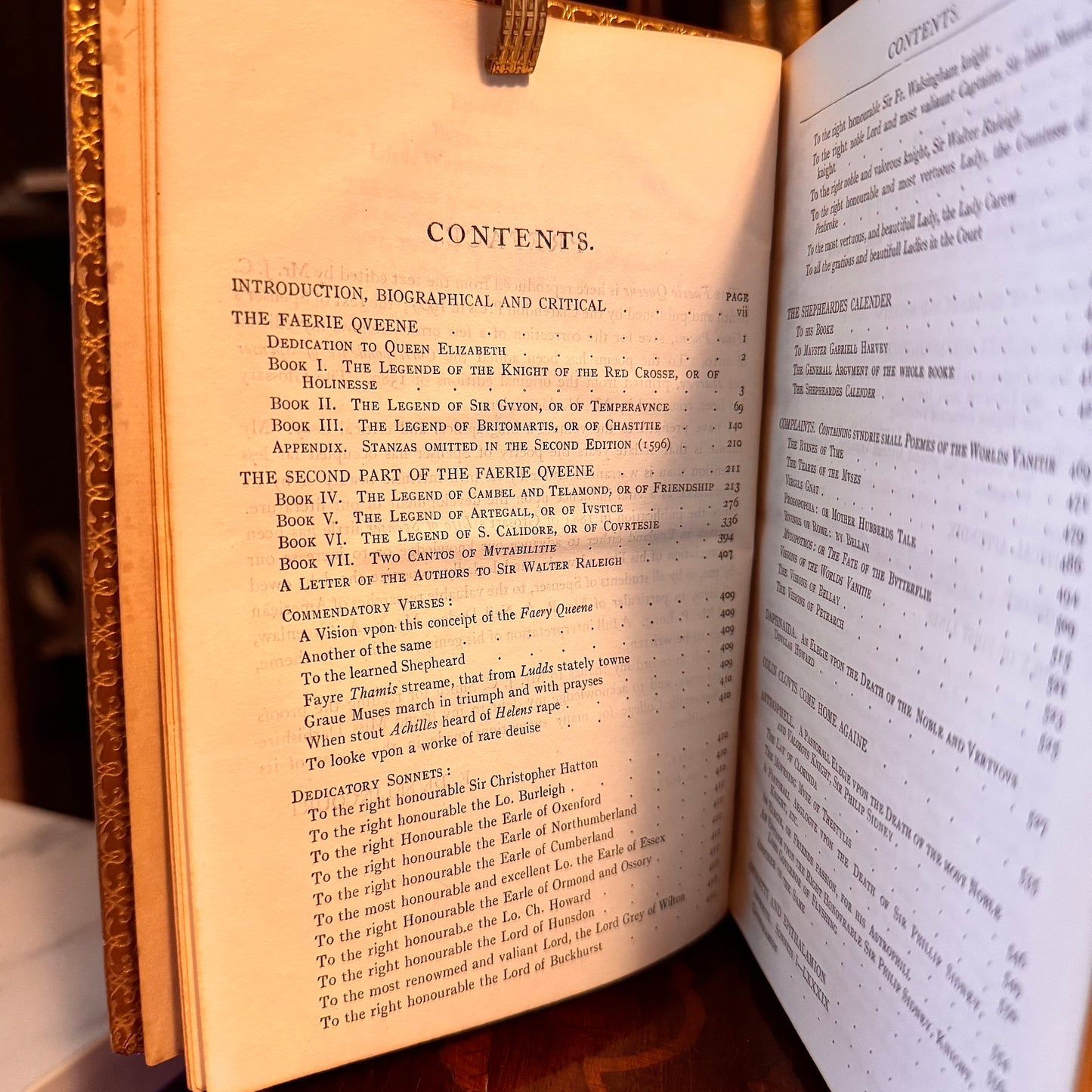
1948 The Poetical Works of Edmund Spenser
Couldn't load pickup availability
Signed binding by the very sought after and collectible binder, Baytun Riviere. See notes about the binders below. Full leather fine binding.
The Faerie Queene by Edmund Spenser is a massive 16th-century allegorical epic poem written to "fashion a gentleman" in virtuous discipline. It glorifies Queen Elizabeth I (represented by Gloriana) through stories of knights, such as the Redcrosse Knight (Holiness) and Britomart (Chastity), who fight monsters and vices to promote Protestant morality and political ideals.
Condition: Some bumping and scratching to boards, as pictured. Minor foxing, mostly near first few pages. Splitting to hinges as pictured. Reinforced internally with PH safe book glue. Spine in great condition, very minor wear. Please review all photos closely for specific condition details.
About the binders:
The British Museum has an article about them on their website, linked below as well as a Wikipedia article about Robert.
- Riviere and Sons opened in 1829 in Bath, England.
- Robert Riviere set up business as a book seller and later a book binder.
- The excellent workmanship and good taste displayed in his bindings won them the appreciation of connoisseurs, and they were largely employed by the Duke of Devonshire, Samuel Christie–Miller, Captain Francis Kapper Brooke, and other great collectors.
- He also bound for the queen and the royal family.
- At the Great Exhibition of 1851, he exhibited several examples of his skill and he was awarded a medal.
- He also restored and bound the famous Domesday book now preserved in the record office. The 1086 Domesday Book, comprising Great and Little Domesday, is preserved at The National Archives in Kew, London, formerly the Public Record Office. It is kept in highly controlled, archival conditions. The two-volume survey of England and parts of Wales, ordered by William the Conqueror, is considered an invaluable primary source for medieval history and remains a significant legal document.
In 1840 he moved to London, where the firm traded at a series of addresses. His grandson Percival Culkin became a partner in 1881 and the firm’s name was changed to Robert Riviere and Son. Percival‘s younger brother, Arthur, became a partner in 1889. Arthur’s son, Stuart Riviere Culkin entered the business in 1908 and was with the firm when it closed in 1939. Robert Riviere‘s brother was the painter Briton Rivière, best known for his animal paintings.
The excellent workmanship and good taste displayed in his bindings, gradually won for them the appreciation of connoisseurs, and they were largely employed by the Duke of Devonshire, Samuel Christie–Miller, Captain Francis Kapper Brooke, and other great collectors. He also bound for the queen and the royal family. At the Great Exhibition of 1851, he exhibited several examples of his skill and he was awarded a medal. He also restored and bound the famous Domesday book now preserved in the record office.
The British Museum has an article about them on their website, linked below as well as a Wikipedia article about Robert.
https://www.britishmuseum.org/collection/term/BIOG211947
Share